
Case Study: Inland
The relationship started the way a lot of our best projects do: a shared passion for growing through manufacturing. We connected with a local manufacturer at an industry event, and the conversation quickly turned to their end-of-line packaging constraints.

Product arrived at the end of the line and packing was still done by hand. When staffing was thin, the packing station stopped, and the rest of the line followed. The manufacturer couldn’t reliably staff the positions, and every open shift on the packing line was leaving yield on the table.
The line also runs four product SKUs, so the system needed to handle fast changeovers between configurations without extended downtime.
DEVELOP designed and built a fully automated end-of-line system inside a 21.5 x 17.5 ft safety cage: robotic case packing, case erecting, sealing, labeling, and palletizing. Two FANUC robots, four SKU configurations, sub-four-minute changeovers. The system was designed around one requirement: the packaging process could not become the constraint again.
Pick-to-Pick Cycle Time
SKU changeover time
System design
Automation System Layout
The packaging system was designed as a single end-of-line machine that connects product handling, case packing, case sealing, and palletizing within one layout. Product enters the packing station directly from the production line. After cases are filled, they move through sealing and labeling before entering the palletizing area.


Engineering a High-Speed Packaging Systems Design for End-of-Line Automation
The new system replaced the manual packing station with a coordinated end-of-line packaging automation system designed to keep pace with the production line. Product arrives from upstream roughly every 4.2 seconds and moves directly into a robotic case packing station powered by a high-speed case packing Fanuc robot. The case packing robot receives product from the conveyor and loads it into erected shipping cases while maintaining the same production rhythm.
Case handling is managed through an automated case erecting system positioned ahead of the packing robot. Once filled, cases move through sealing and labeling before entering the palletizing area. Finished cases are then organized onto pallets by a robotic palletizing system designed to maintain continuous product flow from the packaging line through shipment preparation.
All equipment operates within the same control architecture. Robotics, conveyors, and mechanical systems were engineered to operate as a single packaging platform, so that the product continues moving through the system without accumulation at the end of the line.
The automation platform integrates multiple disciplines that DEVELOP regularly applies in manufacturing environments:


Mechanical layout, conveyor routing, and equipment placement were designed around product flow rather than individual machines. This approach keeps automated packing operations synchronized with upstream production while supporting multiple product SKUs.
The result is a fully automated packing system capable of sustaining high-speed throughput while maintaining the flexibility required for mixed production.
Automation System Snapshot
System Type
End-of-line packaging automation system
Automation Scope
- Robotic case packing
- Case erecting automation
- Automated case labeling
- Case sealing system
- Robotic palletizing
- Pallet buffering
Production Throughput
Pick-to-pick cycle time: Approximately every 4.2 seconds
Changeover Method
SKU changeovers are completed by:
- Swapping modular end-of-arm tooling
- Selecting the correct product recipe on the HMI
- Restarting production
Typical changeover time: < 4 minutes
Core Technologies
- Industrial robotics
- Modular end-of-arm tooling
- Quick-change tooling architecture
- Industrial HMI control system
- Real-time production dashboards
- Multi-robot coordination
Modular Tooling for Fast Changeovers
The line runs several product variants, so the packing system needed to adjust quickly between SKUs. DEVELOP designed a modular end-of-arm tooling system for the case packing robot. Four tooling configurations handle the different product geometries and case layouts used on the line.
Each tool mounts to the robot through a quick-change tooling interface, so that operators can swap tooling directly at the machine. The changeovers themselves follow a simple process. The operator installs the required tool, selects the product recipe on the HMI, and restarts the system. Motion parameters and pick patterns adjust automatically based on the selected configuration.
Typical changeover time is under four minutes. That allows the packaging line to switch between product runs without extended downtime.
Case Tilt Mechanism for Product Stability
The product did not naturally settle inside the case during high-speed loading. When items entered the case too quickly, they could shift or tip. That created the risk of inconsistent packing or occasional jams.
DEVELOP addressed the issue with a mechanical case tilt mechanism built into the packing stage. As the robot loads the product, the case tilts slightly to guide items into position. The adjustment helps each product settle correctly during the loading sequence. It allows the robot to maintain packing speed while keeping product placement consistent inside the case.
The mechanism was designed as part of the overall machine layout so the packing process remains stable during continuous production. Mechanical solutions like this are often critical in packaging automation systems. DEVELOP’s Mechanical Engineering team designed the handling mechanism to maintain packing accuracy while sustaining production speed.
Coordinated Robotics Across Packing and Palletizing
The system uses two robotic stages within the end-of-line packaging process.
A FANUC LR Mate handles the high-speed case packing, loading product into erected shipping cases at the same 4.2-second rate the line produces it. The LR Mate runs four end-of-arm tooling configurations through a quick-change system, one for each SKU the line produces.
A FANUC M-710 handles both case erection and palletizing. Using the larger robot for dual duty is what made the compact footprint possible. A conventional layout would separate erection and palletizing into independent systems and require significantly more floor space. Consolidating both functions onto the M-710 kept the entire system inside a 21.5 x 17.5 ft safety cage with a walkable perimeter around the machine.
Both robotic stages operate within the same production rhythm as the upstream line. That coordination keeps product moving through packing and palletizing without accumulation between stages.
Conveyors, controls, and robot motion were engineered together so each stage remains synchronized with the overall packaging flow. DEVELOP configured the robotic systems as part of its work as a FANUC Authorized System Integrator, ensuring reliable operation at the required packing speed.
The result is a continuous end-of-line packaging process that keeps pace with the production line.
HMI Control and Production Visibility
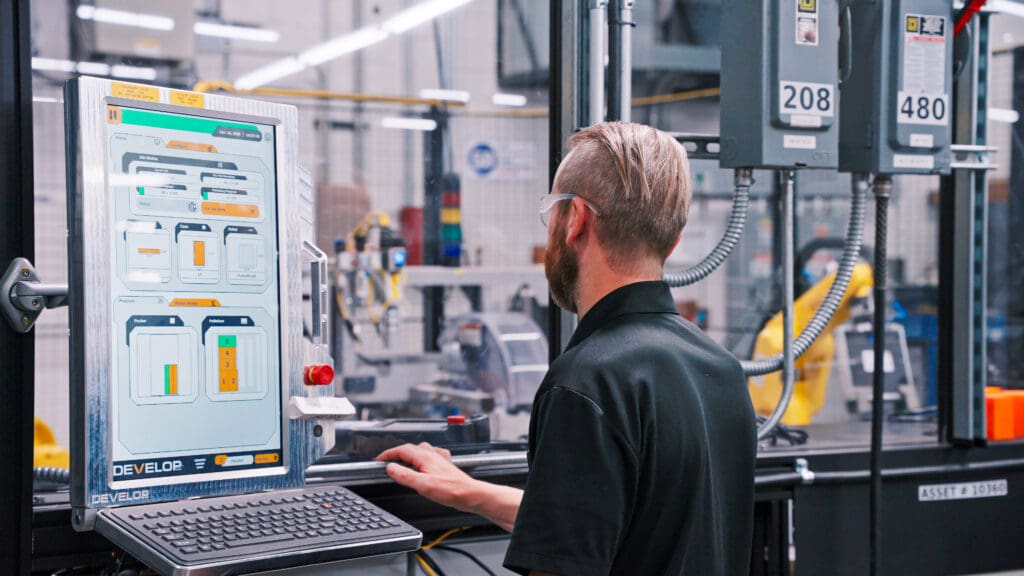
The system includes a centralized industrial HMI that operators use to manage the packaging system. Through the interface, operators select product SKUs, load the correct job recipe, and monitor machine status during production.
When a product changeover occurs, the selected recipe automatically loads the required robot motion parameters and handling sequences. That allows the system to switch between product configurations without manual adjustment of the equipment. The HMI also provides machine diagnostics, fault alerts, and system status information so operators can respond quickly when interruptions occur.
Production data from the system is also sent to remote dashboards used by engineering and management teams. These dashboards track machine utilization, throughput, and system status during operation. The visibility helps teams monitor packaging performance and identify production constraints while the line is running.
Packaging Automation Results and ROI
The packaging line automation system delivered measurable improvements in throughput, labor reduction, and operational consistency. By implementing automated packing and a high-speed case packing robot, the manufacturer eliminated a major production bottleneck.
Manual Packing Removed
The manual case packing station was replaced with a robotic packing system. The line now runs without relying on operators to keep pace with production output.
Packing Speed Matches Production
The system receives product from the upstream line roughly every 4.2 seconds and maintains that pace through packing and palletizing. End-of-line operations no longer restrict line speed.
Fast Product Changeovers
Operators switch between product configurations by installing the correct end-of-arm tooling and selecting the corresponding recipe on the HMI. Typical changeover time is under four minutes.
Consistent Case Loading
Robotic handling maintains consistent case loading and palletizing across shifts. Product placement remains stable regardless of operator availability or staffing levels.
Expandable System Design
The same system layout can be applied to additional lines if production capacity increases, which gives the manufacturer a clear path for expanding automation.
The system allowed the manufacturer to run the packaging line at full production speed across all shifts without dedicated packing operators. End-of-line packaging is no longer a staffing-dependent constraint, and the higher yield directly offsets the labor the manufacturer couldn’t reliably staff.
The manufacturer has since planned follow-on deployments to replicate this system into additional facilities.
“This one-off machine is better integrated and has a better user experience than machines we’ve bought for our field that there are dozens of.” — Plant Manager during commissioning
Matt’s Notes from the Factory Floor
End-of-line packaging is where a lot of production lines run into trouble. The rest of the line gets faster, and the packing station stays manual. Eventually the whole operation settles into the speed of the slowest step.
What made this build interesting was the constraint set. Four SKUs running through every stage. Case erection and palletizing on the same robot. Quick-change tooling across the packer. And the whole thing had to fit inside a 21.5 by 17.5 foot cage. This system didn’t exist before we built it.
The HMI is what ties it together. Operators swap the tool, select the recipe, and restart. No reprogramming, no manual adjustment. The facility officer told us during commissioning that this one-off custom machine has better integration and a better user experience than production machines they’ve deployed across multiple facilities. That’s the standard we’re trying to hit on every build.
The manufacturer has follow-on projects planned to deploy this system into additional facilities. We built the ecosystem once. Now it replicates.

Automating End-of-Line Packaging
Many production lines run well upstream but slow down at the packing station. End-of-line packaging automation removes that bottleneck and keeps product moving through packing and palletizing at the same rhythm as production.
DEVELOP designs and builds packaging automation systems that combine robotics, mechanical engineering, and controls into a single machine.
Business growth is rarely limited by the fastest machines on the floor. More often, it’s defined by the slowest process at the end of the line. Don’t let bottlenecks limit what your business is capable of.