

Modern manufacturing faces real challenges. Rising labor costs, unpredictable supply chains, and the constant push for higher quality and faster production. In this environment, Human-in-the-Loop (HITL) automation is becoming essential. It’s a powerful combination of human intelligence and machine precision that drives significant productivity gains.
Defining Human-in-the-Loop (HITL) Automation
Human-in-the-Loop (HITL) automation is about bringing human intelligence and judgment together with the speed and precision of machines to get work done. This isn’t like old-school automation where humans and machines mostly stay separate. Instead, HITL blurs those lines, creating a system where people and machines truly collaborate, complementing each other’s strengths.
In a HITL setup, automated systems often do the heavy lifting and repetitive tasks. But people are strategically placed to step in when a job needs nuanced judgment, complex problem-solving, or critical decisions. Human-machine interaction is a continuous cycle. Humans keep an eye on things, supervise, and refine what the machines are doing. This helps the system learn and get better over time. It means our automated systems adapt to subtle patterns and unusual situations that a purely automated system might miss. This is the essence of effective human robot interaction.
Another key area for Human-in-the-Loop automation is when fully automating a system doesn’t yet deliver the desired ROI. In these cases, it makes strategic sense to begin with HITL, allowing manufacturers to implement automation in high-impact, widely applicable areas like palletizing or machine tending.
This approach delivers immediate value while still enabling customization for the parts of your workflow that are unique to your business, such as packaging, inspection, or specialized post-processing. It’s a way to get the benefits of lean automation without a massive upfront commitment.
The Key Benefits of HITL in Manufacturing

Bringing Human-in-the-Loop automation into your factory delivers a lot of benefits that directly boost factory productivity and overall operations:
- Improved Accuracy: By having human oversight and judgment, HITL significantly improves the accuracy of automated processes. This is vital for jobs needing high precision, like quality control, where human inspectors make the final call on potential defects.
- Enhanced Productivity: HITL automation dramatically increases productivity by automating repetitive and mundane tasks, freeing up your team to focus on more strategic, complex, and higher-value activities. That saves you considerable time and money.
- Reduced Costs: Automating tasks that used to be done by hand directly leads to big cost reductions, especially if you have a lot of repetitive work.
- Increased Speed and Control: HITL makes your operations more agile and responsive to market changes. You can easily reconfigure workflows for new demands, giving you more speed and control over production.
- Continuous Learning and Evolution: A crucial part of HITL is that it keeps getting better. With human feedback and oversight, these systems learn, adapt, and evolve over time, helping them handle complex tasks and unusual situations that fully automated systems might miss. This adaptability becomes a real competitive advantage in a changing market, allowing factories to quickly adjust production lines, introduce new product variations, or respond effectively to unforeseen supply chain disruptions, thereby ensuring long-term operational resilience and market responsiveness. This embodies continuous improvement (Kaizen) in action.
- Maximizes Capital Utilization: By automating standard, high-impact tasks (like palletizing or machine tending) first, businesses can generate immediate returns and free up resources. This staged approach ensures that capital is used where it delivers the greatest value, while still allowing for tailored automation in areas unique to your operations, promoting lean automation.
The fact that these systems learn and adapt means we’re building flexible manufacturing environments. Human judgment provides critical context that machines often lack, allowing the system to adapt to nuances. A continuous feedback loop means ongoing optimization, turning your processes into living systems that improve over time.
The Indispensable Role of Human Judgment in Automated Workflows
Within a HITL framework, people are critical to shaping and improving how things get made. They monitor machine performance, ensuring it meets goals, and step in to fix problems. Human strengths like decision-making, creative thinking, and problem-solving are invaluable in areas like industrial product development, quality control, and strategic planning—skills that machines have yet to fully replicate. This enables a truly flexible manufacturing system.
Here are some real-world examples of HITL in action:
- Quality Control and Verification: Automated systems can flag defects, but human inspectors provide the final judgment, ensuring real accuracy and maintaining product quality. Humans can identify inefficiencies or quality issues that machines might miss, and propose iterative improvements that enhance overall workflow effectiveness, leading to continuous improvement (Kaizen).
- Predictive Maintenance: While AI can monitor machinery for potential issues, human experts review those alerts, analyze the data, and make informed decisions on whether maintenance is truly needed. This prevents unnecessary downtime and costs.
- Supply Chain Management: AI can handle routine tasks like data entry. But for complex custom orders or sudden changes in demand, human intervention is necessary for critical decisions and adjustments.
- Human Dexterity for Complex Tasks: There are many tasks requiring fine motor skills, adaptability to subtle variations, or complex End-of-Arm Tooling (EOAT) for robots. In these situations, human dexterity can be far more efficient and cost-effective than trying to fully automate, making human robot collaboration ideal.
The beauty of HITL is that it lowers the barrier to entry for advanced automation. For manufacturing leaders worried about the high upfront costs and complexity of fully autonomous systems, HITL offers a smarter, more financially sensible starting point. This approach, promoting lean automation, allows organizations to gain immediate benefits, build internal expertise, and gather real-world performance data with reduced upfront commitment, before scaling to higher levels of autonomy.
By keeping human oversight, HITL provides a crucial safety net, reducing the risks of AI misinterpretations or errors. It allows you to get immediate benefits, build internal expertise, and gather real-world data with less upfront commitment before scaling up. The HITL approach makes advanced manufacturing more accessible to all businesses, including small and medium-sized enterprises (SMEs), boosting overall factory automation and productivity while driving business growth.
Introducing the Modular Robot System (MRS) for Collaborative Workflows
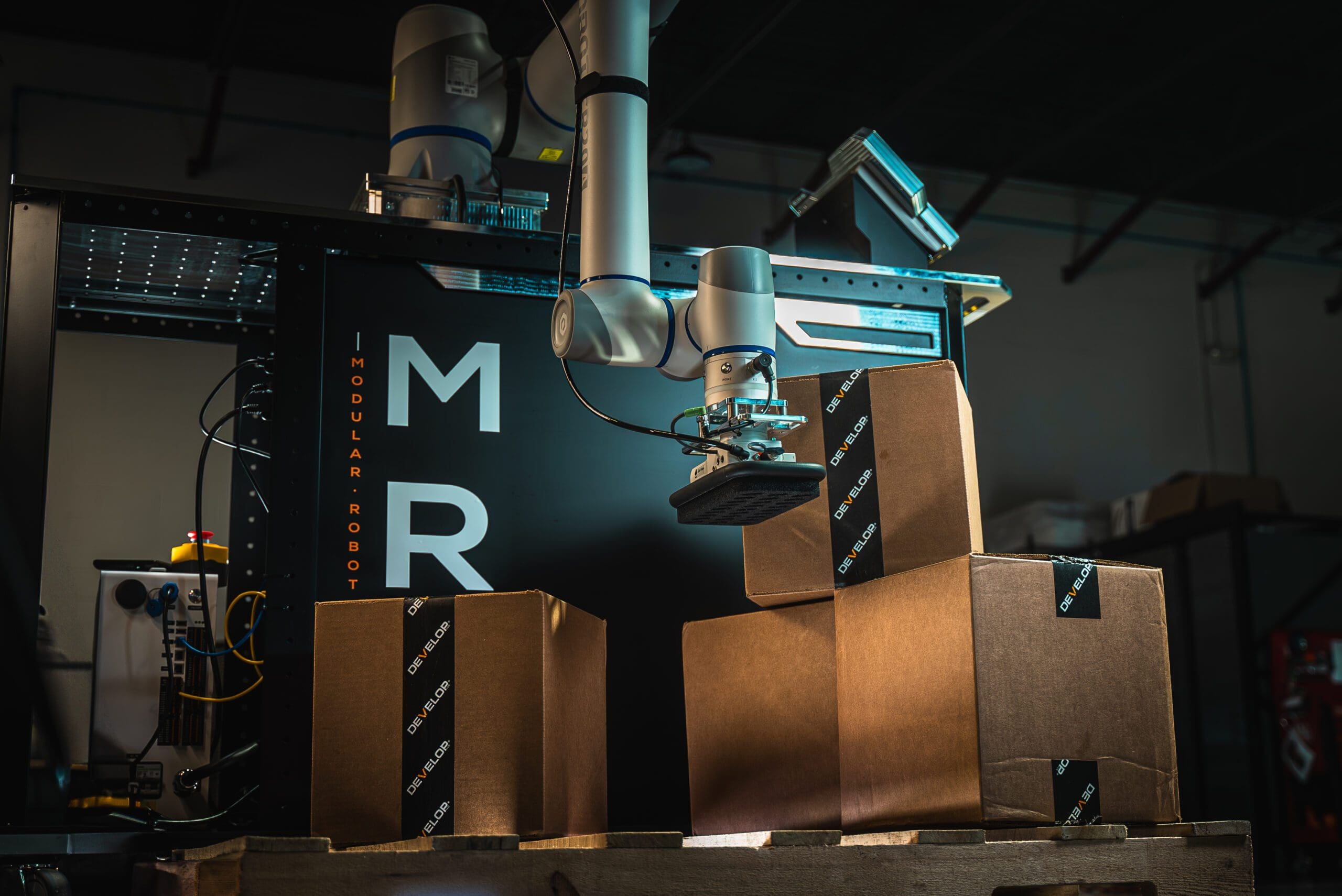
At DEVELOP LLC, our Modular Robot System (MRS) is a reconfigurable and mobile robotic platform. We designed it specifically to accelerate end-of-line automation for manufacturers of all sizes. Think of it as a portable robot cell, engineered for quick deployment across many different jobs in your factory.
The MRS offers turnkey modular robotics functionality, making complex automation tasks simpler and advanced robotics more accessible, even for businesses with limited resources or space. Its design tackles the challenges of traditional robotic installations, which are often complex and costly, by offering a more adaptable solution. This is our answer to providing truly affordable robotics.
Core Features and Capabilities of the MRS
The MRS stands out because of its flexibility and efficiency:
- Versatility and Robot Compatibility: The MRS combines a powerful robotic arm with a mobile base, making it incredibly versatile. It’s designed to work with robotic arms from leading manufacturers like Fanuc, Dobot, UR, and Doosan. The wide compatibility means you can equip the MRS with many types of robotic end-of-arm tooling to perform diverse automation tasks.
- User-Friendly Control (HMI): A key feature is its intuitive Human-Machine Interface (HMI) and MRS software. The user-friendly design simplifies operation and task customization, significantly reducing the need for specialized programming expertise. Your existing team can quickly learn to operate and adapt the system, boosting efficiency. A focus on an intuitive HMI directly supports the Human-in-the-Loop model. By making the robot easy for your team to program and interact with, it reduces training burdens and potential resistance.
- Modular Expandability: The MRS has a configurable modular robotics design, allowing for easy integration of additional accessories. You can quickly reconfigure it to enhance agility or expand its functions, for instance, by changing out robotic structures or end effectors without extensive reprogramming.
- Mobility: Equipped with locking/lifting casters, the MRS is incredibly mobile. Its compact, wheeled design allows for rapid movement and redeployment to different factory areas. It drastically cuts down downtime between tasks and maximizes the use of your robotic automation resources.
- Data-Driven Oversight and Remote Diagnostics: With systems like the MRS, real-time data analytics and remote monitoring allow human managers to stay in the loop at a strategic level. That data leads to better decision-making for capital planning, maintenance scheduling, and overall manufacturing optimization, ensuring the right investments are made at the right time for maximum operational efficiency, greatly enhancing your flexible manufacturing system.
MRS Applications in Manufacturing
The MRS is a highly versatile solution, fitting smoothly into a wide range of robotic automation processes. Typical applications include end-of-line packaging, palletizing, de-palletizing, case labeling, case erection, material handling, quality control, pick and place, assembly, and machine tending. Its ability to handle such a wide range of tasks makes it a flexible and efficient tool for many operational needs.
Enabling Human-Robot Collaboration with MRS
Crucially, the MRS is designed for human-robot collaboration. This makes it possible for manufacturers to use advanced robotic solutions even when full automation systems might be too costly or complex. The MRS isn’t just a robot a human can work around. It’s designed from its core to enhance the Human-in-the-Loop model.
Its mobility allows human operators to strategically deploy the robot where their unique judgment or intervention is most needed. The intuitive HMI helps your existing team to directly interact with and program tasks without needing extensive coding knowledge. This approach maximizes the collaborative potential, reduces adoption friction, and ensures the human element is an active, integrated part of the automated workflow. The HITL becomes a practical and effective reality on your factory floor.
DEVELOP LLC’s broad approach to robotics involves using collaborative robots (cobots) designed for safe interaction with humans. Our general robot safety practices include using fixed guards, presence detection (like light curtains), emergency stops, and complying with industry standards like ANSI/RIA R15 and ISO 10218. A comprehensive safety framework ensures that human operators can work alongside or near the MRS safely, reducing workplace injuries and improving employee well-being by handling repetitive or physically demanding tasks.
The MRS as a Driver of Productivity, Scalability, and ROI
The MRS significantly drives factory productivity, scalability, and Return on Investment (ROI) in manufacturing:
- Productivity: The MRS maximizes output and minimizes downtime through efficient operation and quick redeployment. It speeds up prototyping and reduces time-to-market for new products, encouraging in-house R&D. Overall, it increases throughput, reduces errors, and improves product quality through precise robotic operations.
- Scalability: Its portability and reconfigurability allow for easy redeployment to different tasks and production lines, providing crucial flexibility for adapting to changing needs. The modular robotics design also enables easier scaling and expansion, allowing for more robotic assistance during demand spikes.
- ROI: The MRS reduces downtime and maximizes return on investment because it’s flexible and easy to redeploy. Its accessible nature makes it a more achievable solution compared to traditional, often complex and costly, fixed robotic installations.
The MRS’s ability to simplify complex automation tasks and make robotics accessible, especially for businesses with limited resources, positions it as a critical enabler for SMEs to adopt advanced automation and scale. Traditional robot installations often demand big upfront capital and specialized integration, which can be too much for smaller operations.
The MRS’s core strengths, portability, user-friendliness (HMI), and modularity, directly address these constraints. SMEs can make incremental investments, test automation in high-impact areas, and scale their robotic capabilities as they grow, without needing a complete overhaul. That accessibility is vital for boosting overall industry factory automation and competitiveness.
Strategic Assessment as Your First Step to Optimized Operations

For any manufacturer, the first steps into automation can feel like a big unknown. That’s why an Automation Assessment from DEVELOP LLC is so important. It’s designed to be a crucial first step in building automation solutions that not only deliver a strong Return on Investment (ROI) but also directly address your specific challenges.
We are your partner, supporting you from identifying areas for improvement to implementing expert solutions. Our assessment cuts out the guesswork and ensures your investments in new machinery deliver the results you need, preventing costly mistakes.
Tailored Automation Assessments for Your Facility
DEVELOP offers different ways to approach your Automation Assessment, making sure it fits your needs and budget:
- Free Automation Assessment Questionnaire: The free Automation Questionnaire helps you figure out if automation is the right move for your business.
- Free 30-Minute Virtual Opportunity Discussion: After the questionnaire, we’ll schedule a brief chat to understand your specific needs and goals.
- In-Depth Virtual Automation Assessment (Paid): If automation looks like a good fit, we can schedule a more detailed 2-4 hour virtual Automation Insights assessment. We’ll focus on a single project, review your budget and ROI timelines, and use pictures and video walkthroughs of your production floor to analyze things.
- On-Site Automation Assessment (Paid): For an in-depth, company-wide look at automation opportunities, our team comes to your facility. We’ll do a physical tour, work closely with your business and manufacturing professionals, and translate your in-house knowledge into precise machine designs. This assessment carefully balances the concerns of the CEO with the practical needs of machine operators and processing targets, mapping out low-risk, high-ROI options against your budget and goals.
You can also directly buy your Automation Assessment to kickstart your journey immediately. Our flexibility lets you choose the level of assessment that best fits your immediate needs and long-term plans.
Key Insights Provided by the Assessment
At all levels of assessment, you get a clear picture of your automation potential, helping you see where you can get the biggest impact:
- Pinpointing Repetitive Tasks: We identify clusters of tasks that are perfect candidates for automation.
- Uncovering Inefficiencies: We find hidden bottlenecks in your current production processes.
- Quantifying Financial Impact: We look at the financial impact of your current manual processes and calculate your automation ROI.
- Expanding Automation Scope: We identify how automating one process can open doors to automating connected processes.
- Spotting Growth Pathways: We pinpoint areas where quality issues or production rate limits are holding back your business growth.
- Modernizing Equipment: We recommend how to modernize legacy equipment that’s slowing you down.
- Reducing Outsourcing: We identify processes that could be efficiently brought in-house to reduce reliance on unreliable outsourcing.
- Accelerating Innovation: We collaborate on new product development, applying automation to boost manufacturing output, reduce time-to-market, and drive profitability.
- Detailed Planning: We identify engineering risks, projected system costs, and estimated ROI for each opportunity.
- Education on Options: We educate clients on different automation solutions, from basic pick-and-place robots and packaging and palletizing solutions to more complex systems.
The assessment ensures that proposed solutions are not just technically sound, but also strategically smart, financially justifiable, and operationally sustainable. Our integrated planning builds buy-in across all levels of your organization, from the leadership to the shop floor, which is essential for successfully adopting complex systems like HITL automation and our MRS.
Planning for Integration and Workforce Support
A critical part of the Automation Assessment is planning for training, workforce support, and fully integrating new automation into your existing processes. DEVELOP LLC tailors its education and support based on how much operational independence you prefer. We’ve found that a proactive approach ensures your team isn’t just prepared, but truly equipped to work effectively with new automated systems.
Synergizing for Success with HITL, MRS, and the Automation Assessment
The real power of Human-in-the-Loop (HITL) automation comes alive when you combine it with the right tools and a smart plan. That’s where our Modular Robot System and the Automation Assessment fit in.
How the Automation Assessment Guides HITL and MRS Deployment
The DEVELOP LLC Automation Assessment acts as your strategic blueprint for putting Human-in-the-Loop principles into practice and deploying the MRS. By carefully identifying repetitive tasks, hidden inefficiencies, and bottlenecks, the assessment precisely pinpoints where the MRS’s flexible, mobile, and collaborative capabilities will have the biggest impact. That means your automation efforts are focused on areas that deliver the most significant improvements in factory productivity and efficiency.
Crucially, the assessment’s detailed planning for workforce integration, training, and ongoing support ensures that the human element, which is vital for HITL, is easily integrated into MRS operations. The proactive approach makes sure your human operators aren’t just watching, but are active participants, maximizing the benefits of human-robot collaboration from day one.
The MRS’s design, with its portability, reconfigurability, intuitive HMI, and explicit design for human-robot interaction, aligns perfectly with HITL principles.
Its mobility lets human operators strategically deploy and redeploy the robot where their unique judgment or intervention is most critical. The intuitive HMI allows your existing workforce to directly interact with, program, and refine robotic tasks without needing extensive, specialized coding knowledge. Our design philosophy maximizes collaborative potential, reduces adoption friction, and ensures the human element is an active, integrated component of the automated workflow, making HITL a practical reality on the factory floor.
Realizing Tangible Productivity Gains and Cost Savings
The combined power of Human-in-the-Loop automation and the MRS delivers significant, measurable gains in factory productivity and real cost reductions. HITL improves accuracy, frees up your team for strategic tasks, and cuts operational costs by automating repetitive processes. The MRS, with its rapid redeployment, user-friendly HMI, and inherent scalability, further boosts these benefits, maximizing output and minimizing downtime across the factory floor.
The Automation Assessment quantifies these potential gains through detailed ROI calculations. It gives you a clear financial picture of your investment and outlines how automation savings will typically offset initial costs within 1-4 years. Financial clarity is essential for smart strategic decision-making.
Addressing Common Challenges in HITL Automation
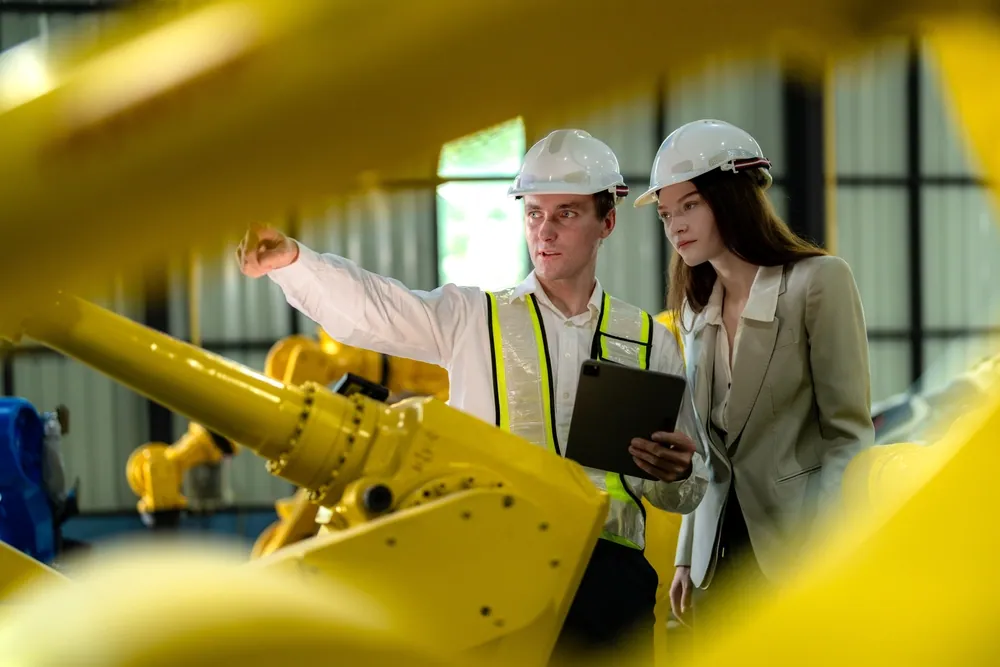
While HITL offers immense benefits, successful implementation means dealing with potential challenges. DEVELOP LLC’s holistic approach, informed by the Automation Assessment, provides comprehensive solutions:
- Data Quality: We implement data validation tools and regular updates to ensure the automation system always works with accurate information.
- Managing Human Error: We establish clear guidelines, provide ongoing training, and build in review checkpoints (like secondary reviews or AI-assisted flagging) to reduce the impact of human error.
- Data Security: We deploy strong encryption, access controls, multi-factor authentication, and regular audits to protect sensitive data and stay ahead of threats.
The assessment’s focus on workforce support and integration planning directly helps overcome these challenges by preparing your team for effective human-robot interaction with new systems.
Beyond ROI and Unlocking New Opportunities for Growth
DEVELOP LLC champions an Opportunity Automation Integration (OAI) philosophy. This goes beyond just immediate ROI. While ROI is important and we calculate it meticulously, OAI emphasizes automation as a catalyst for broader, long-term business growth and competitive advantage.
Doing so unlocks unforeseen opportunities, such as increasing production capacity (by replacing manual lines and freeing up floor space), accelerating product innovation, and strategically reallocating labor to higher-value activities like new sales or business improvements.
Data shows automation can free up human workers for more strategic work, and our OAI philosophy explicitly includes job satisfaction, job opportunities, and increased profits. The Automation Assessment includes planning for training, workforce support, and complete integration. It strongly supports a narrative of workforce transformation and augmentation, rather than simple job displacement.
Ultimately, properly scoped automation integration, guided by DEVELOP LLC, improves speed, safety, consistency, quality, employee retention, and job satisfaction, while creating new job opportunities and significantly increasing profits. A company that embraces these qualities isn’t just surviving, it’s thriving.
Charting Your Future Growth with Intelligent Automation
Boosting factory productivity demands a strategic embrace of Human-in-the-Loop (HITL) automation. By intelligently blending human judgment and adaptability with robotic precision and speed, it becomes a fundamental driver of innovation and sustained growth.
Are manual processes holding your factory back? Are you confident in your current productivity, especially with labor challenges and demands for higher quality?
The time for truly impactful human-in-the-loop automation is now.
Imagine your operations transformed. Dramatically increased factory productivity, consistent quality, a safer, more engaged team, and significantly lower long-term costs. Our modular robotics solutions are designed to make robotic packaging and other automated tasks accessible and impactful for businesses just like yours. This isn’t about replacing your team. It’s about growing them and securing your future in industrial automation with smart, collaborative robots.
Discover unparalleled efficiency and profitability. Experience how precision automation can drive down expenses, improve your output, and provide the scalability you need to grow. DEVELOP LLC is your partner, dedicated to helping you achieve these tangible benefits with proven solutions and dedicated support.
Ready to explore how automation can revolutionize your operations? Take the critical first step by identifying your unique opportunities.
For a quick assessment of your needs, take our Free Automation Assessment Questionnaire. This short survey is tailored to quickly pinpoint your ideal automation targets, setting the stage for personalized solutions. Our Automation Assessment Services offer expert guidance to support you.
Or, if you have a clearer idea of your needs, book an Automation Assessment directly:
- Virtual Assessment: This is a guided, collaborative process. We’ll work with you to answer questions, explore your automation potential, and develop a basic roadmap from wherever you are. It’s perfect if you’re new to automation or want to take a more hands-on approach to discovery.
- On-Site Assessment: For a comprehensive, done-for-you evaluation, our experts will visit your facility. We’ll handle all the details, analyzing your processes and developing a customized automation roadmap. This is ideal if you want a thorough assessment where the experts manage the entire process.
Prefer to have a quick, 30-minute chat about your project or potential for growth? You can do that too. Let’s start driving your business forward so that you don’t get left behind.
Request YourFree Expert Consultation
Our project managers, automation specialists, and machining experts specialize in translating practical manufacturing targets into cost effective automated solutions. Schedule a meeting today to plan your swift return on investment.