
Case Study: Project 2101
A legacy assembly machine was finally running out of runway.
The manufacturer relying on it needed a system that could prove every part met spec and bring production back in-house.
Replacement parts for the machine were disappearing from the market, and the safety design hadn’t kept pace with current standards. The process also had no way to verify torque or connect a finished part back to its build data, so there was nothing to show a customer asking for proof of quality. Because the legacy system couldn’t keep pace with demand, a meaningful share of production had already shifted overseas.
The line also needed to run several product SKUs through the same station, and the original fixturing had no way to adapt between them.
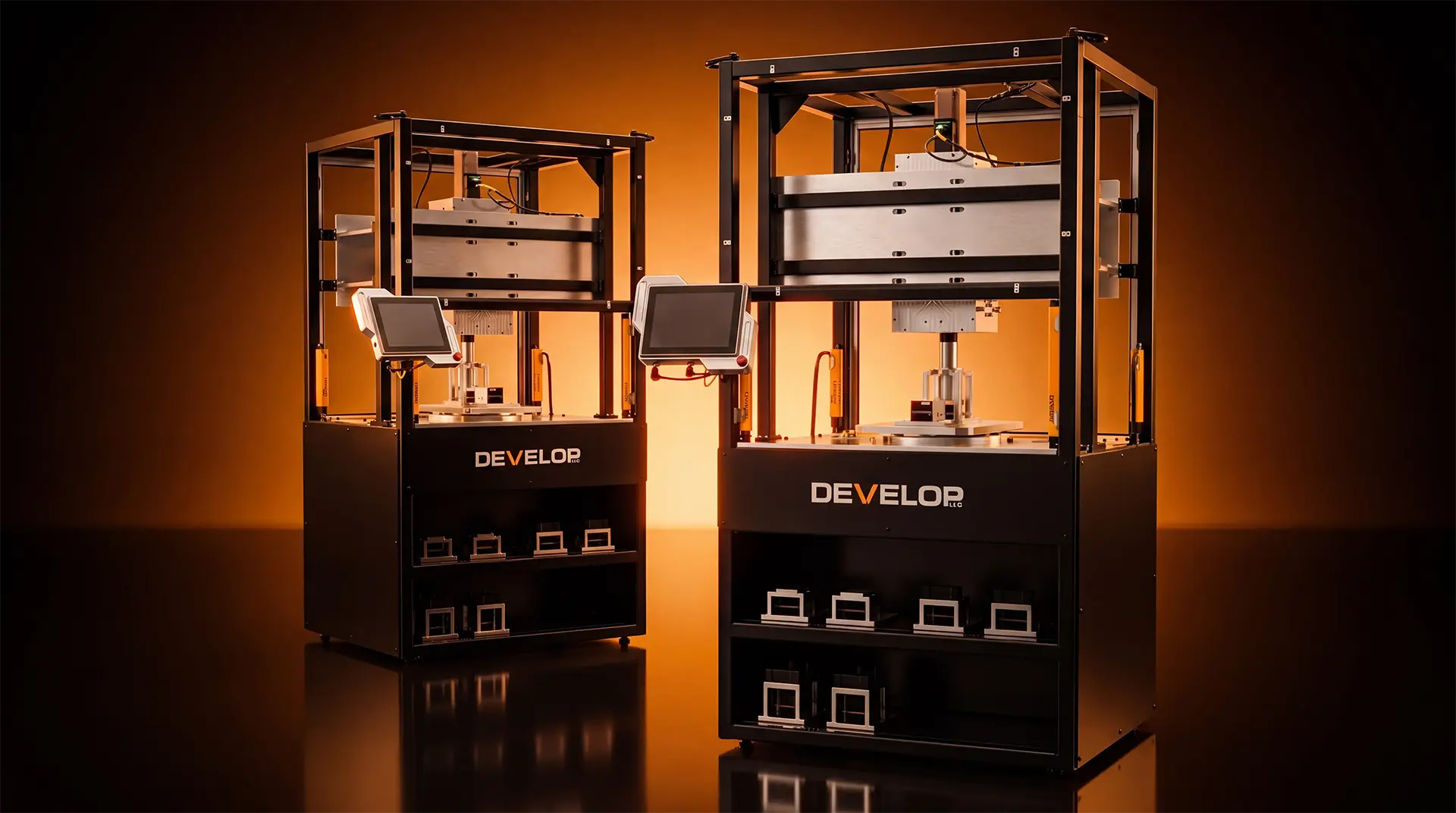
DEVELOP designed and built a fully automated assembly cell as a sub-$300K automation system: torque-regulated fastening, modular workholding, two-position staging, and job-based HMI control. The cell runs multiple SKUs with sub-4-minute changeovers and captures complete torque data on every part.
Increase in machine utilization
SKU changeover time
Torque pass rate
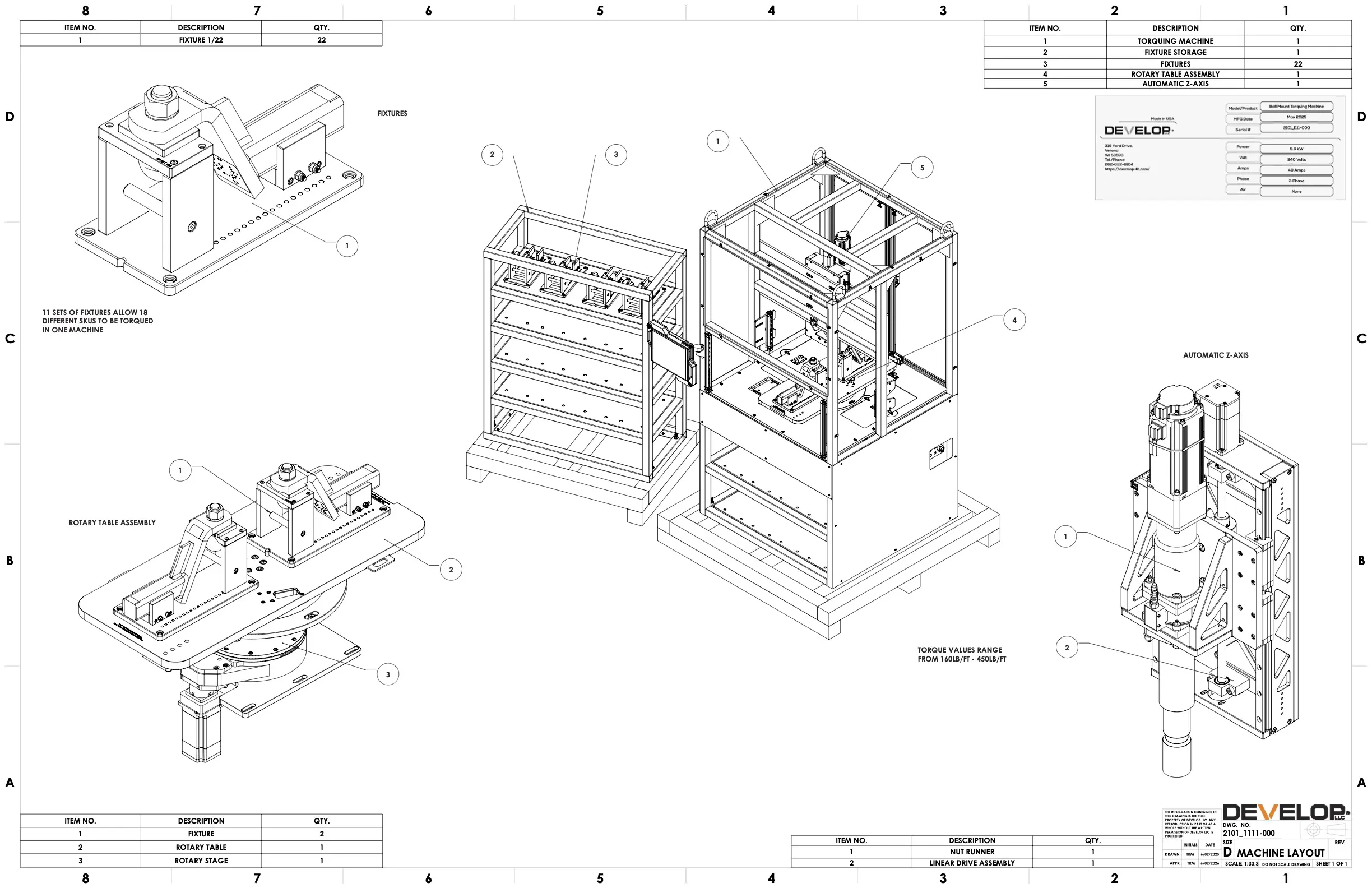
Assembly Cell Layout
The assembly cell was engineered as a single connected line, from load through torque application, staging, and release. Product enters at the fixturing station and moves into the torque-regulated nut runner. From there, it cycles back to the operator, to take out the finished part and input the next un-torqued part.

Engineering a Custom Automation System for Multi-SKU Assembly
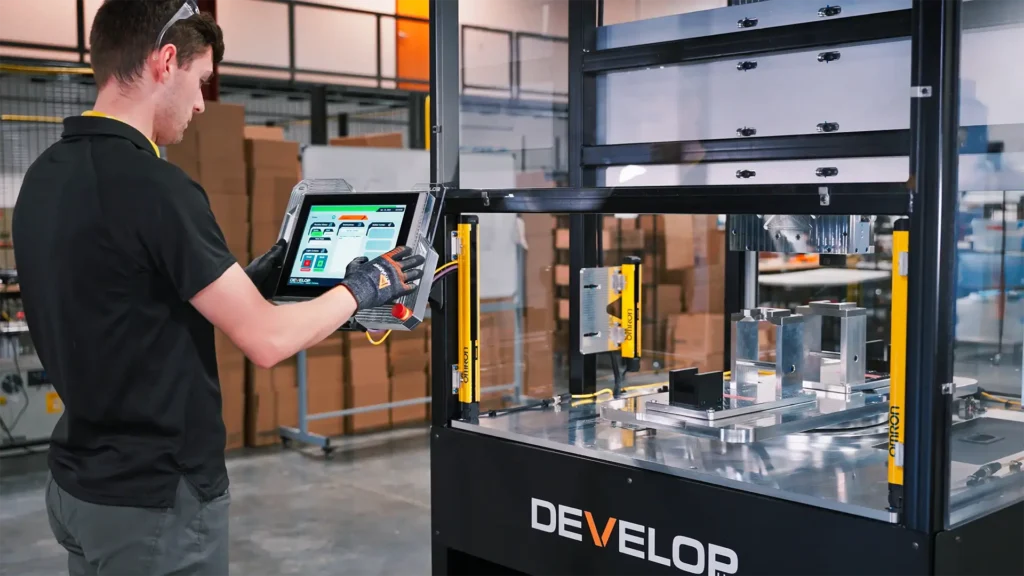
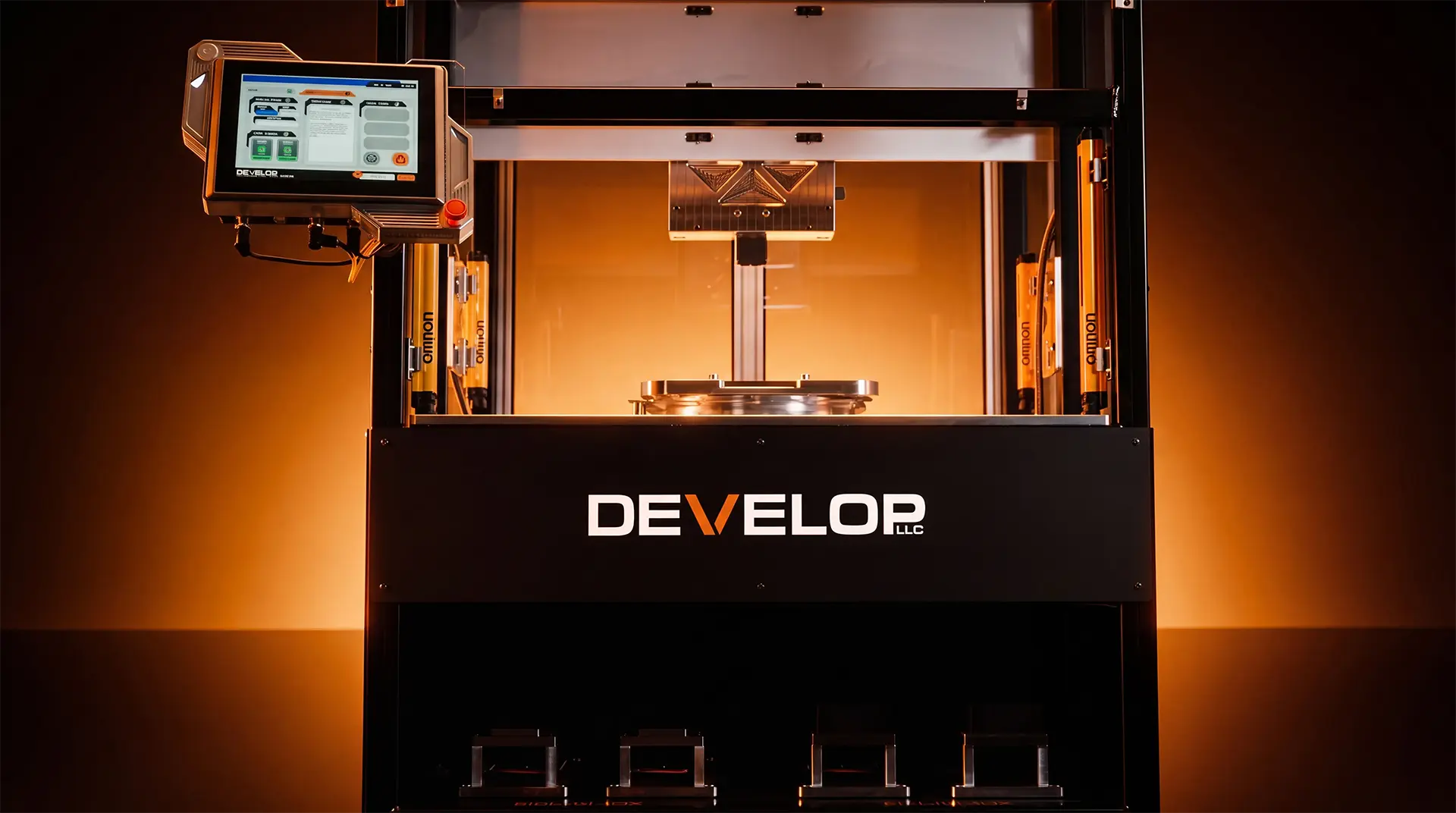
Project 2101 replaced a manual, single-configuration process with a coordinated assembly system built to run several product SKUs without slowing down. Parts load into modular workholding, and a torque-regulated nut runner applies and records the fastening cycle against a documented standard. From there, product moves into two-position staging, which lets the operator input the next part while torque and inspection steps complete. A job-based HMI ties the system together: operators call up a stored configuration, and the machine adjusts its motion and torque parameters to match.
All of it runs on a single control architecture. The nut runner, staging system, and workholding were engineered to operate as one assembly platform, so product keeps moving without the manual handling steps the legacy process relied on.
The automation platform integrates multiple disciplines that DEVELOP regularly applies in manufacturing environments:
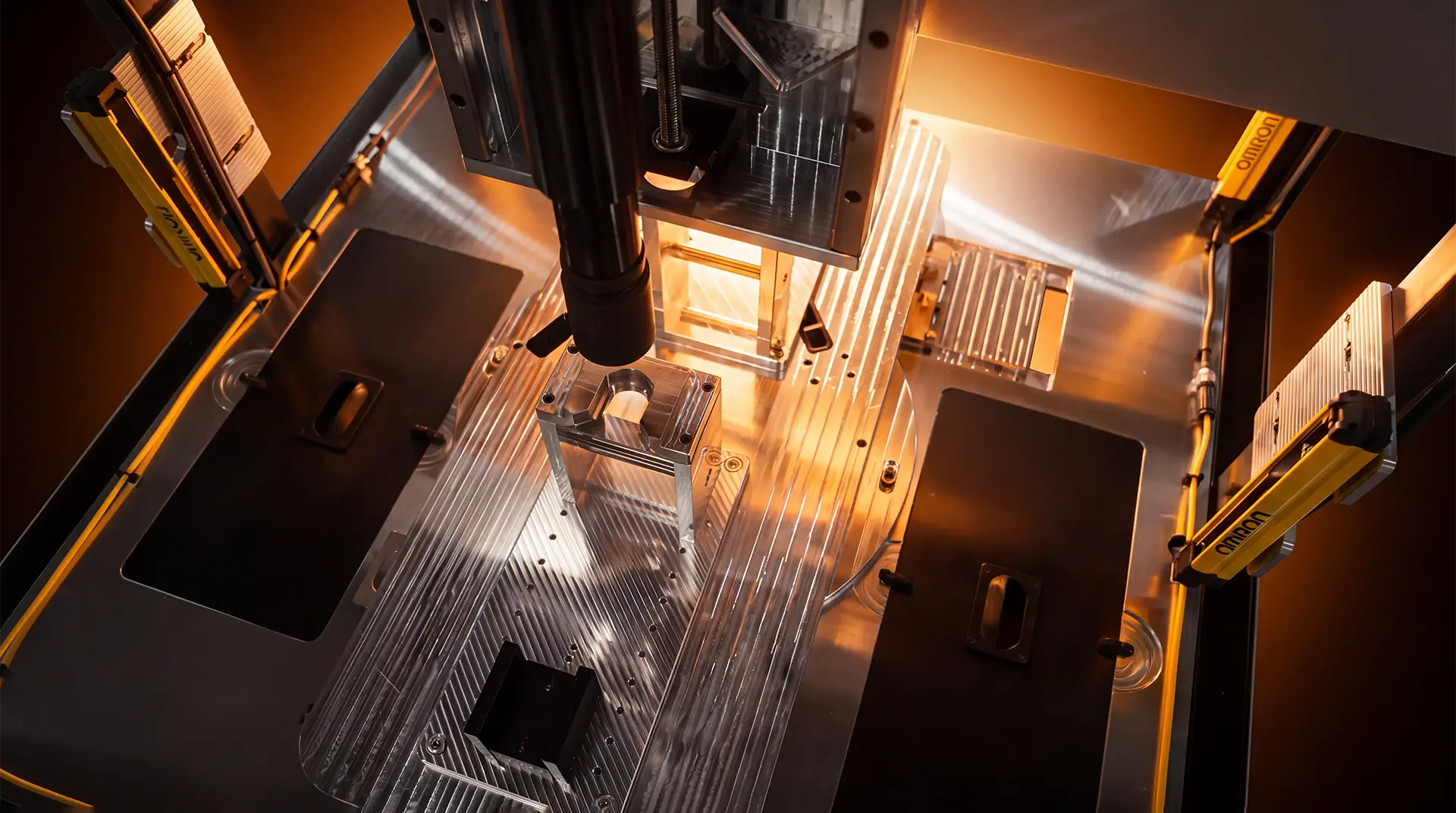
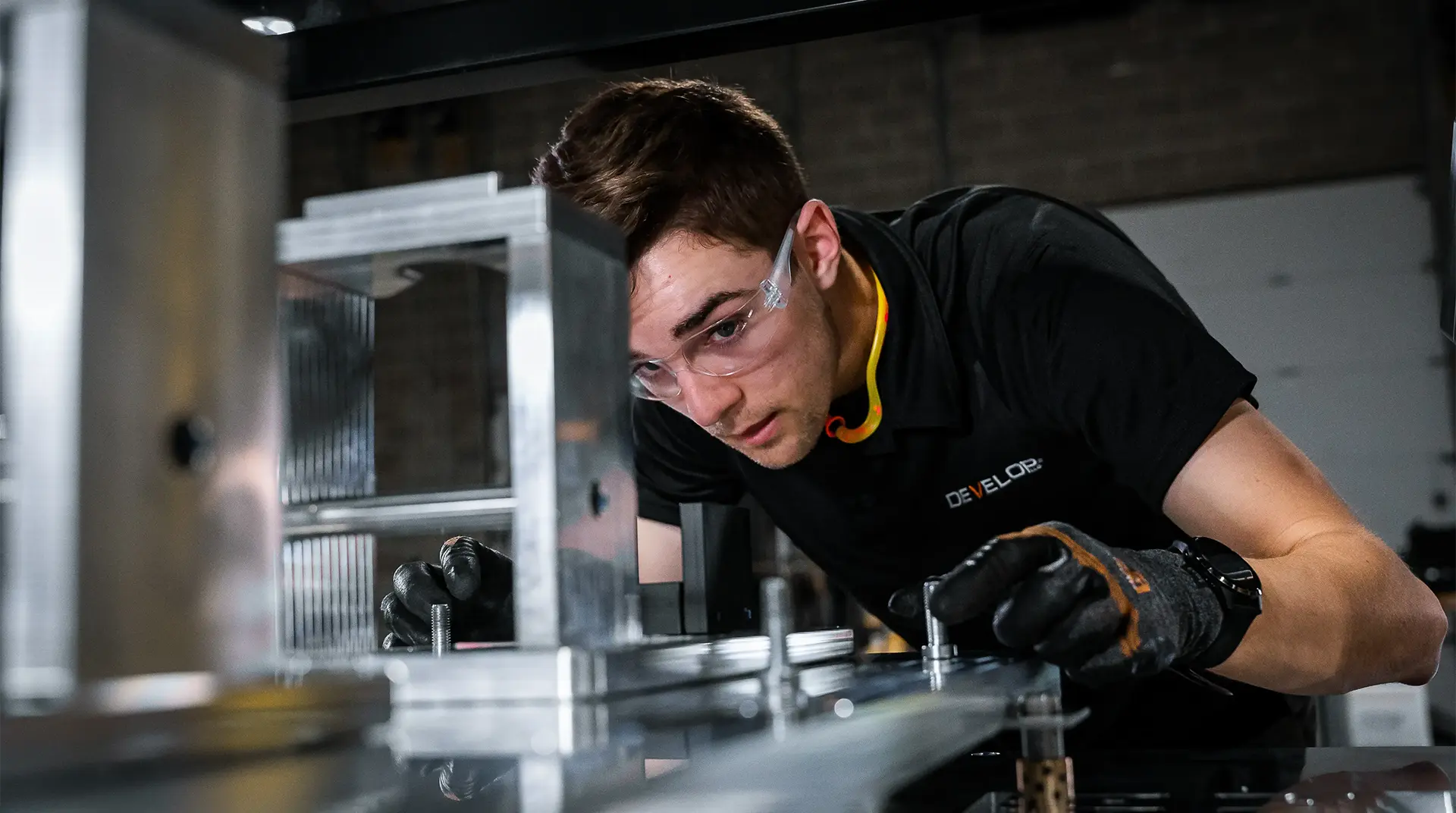
Mechanical layout and fixturing design were built around the part, not a single station. That keeps torque accuracy and cycle time in sync while supporting multiple SKUs.
The result is a fully automated assembly system capable of sustained throughput while maintaining the quality traceability the legacy process never had.
Automation System Snapshot
System Type
Automated nut and bolt assembly cell
Automation Scope
- Torque-regulated fastening
- Modular workholding
- Two-position staging
- Job-based HMI control
- Scratch-free product handling
Production Throughput
Units per hour:: 120 , up from 90
Machine Utilization
Machine utilization increased by 100% following automation.
Changeover Method
SKU changeovers are completed by:
- Selecting the stored job configuration on the HMI
- Adjusting modular workholding to the new SKU
- Restarting production
Typical changeover time: 2 to 3 minutes.
Core Technologies
- Torque-controlled nut runner
- Modular fixturing system
- Two-position staging architecture
- Industrial HMI job control
- Data tracking and quality validation
Modular Workholding for Multi-SKU Changeovers
The line runs more than one product configuration, so the fixturing had to move with it. DEVELOP built modular workholding that swaps between SKUs without tearing the fixture down.
Operators select the part number and load the stored configuration through the job-based HMI. The machine sets itself up from there. Typical changeover time runs 2 to 3 minutes, start to finish.
Two-Position Staging and Scratch-Free Workholding
Torque application takes time to do correctly, and the legacy process had no way to absorb that time without slowing the line down. A single-position station would have forced the cell to sit idle during every torque cycle.
DEVELOP addressed this with a two-position staging system built into the cell. While one part completes its torque cycle, the next part loads and stages in parallel, which is what keeps the system at full cycle speed. The design was built as part of the overall cell layout, so torque accuracy and production speed didn’t have to trade off against each other.
The product’s finish mattered just as much. Standard fixturing and clamping surfaces risked marking parts during handling, so DEVELOP’s Mechanical Engineering team designed scratch-free contact surfaces at every point the product touches the fixture, holding parts securely through the torque and staging cycle without marking the finished product.
Torque Control and Full Traceability
Quality control was the piece the legacy system never had.
Every unit now passes through a torque-regulated nut runner, and every cycle gets logged against the individual part it tightened, with a timestamp and result attached to that unit specifically.
The nut runner, staging system, and HMI all run on the same control architecture, so torque data, part tracking, and cycle timing point back to the same job record. That coordination is what makes full traceability possible without slowing the line down.
Every unit built on the new cell carries torque tracking data, and the pass rate is running at 99.86% based on production data from the floor. That’s a quality record a customer can verify directly.
Job-Based HMI and Production Control
Operators run the cell through a job-based HMI. They select the part number, load the stored configuration, and the system sets its own motion and torque parameters.
Machine diagnostics and status information run through the same interface, so operators can see what the system is doing without needing a manual to interpret it.
Results
The automated cell delivered measurable improvements in throughput, quality, and labor efficiency. By replacing the legacy machine with a torque-controlled system, the manufacturer eliminated a production risk and a quality risk at the same time.
Machine Utilization
Machine utilization increased by 100% following automation, with more consistent output across shifts.
Scrap Reduction
Modular workholding and controlled handling cut cosmetic defects. Estimated scrap reduction: approximately 10%.
Torque Traceability
Every unit, 100% of them, carries torque tracking data, with a 99.86% torque pass rate based on production data.
Labor Reduction
What used to take four operators now takes one, freeing three people for the higher-value work, while the cell itself outputs more than the process it replaced.
Changeover Speed
Operators move between SKUs in 2 to 3 minutes.
The system let the manufacturer run the assembly cell at full production speed with a fraction of the labor the legacy process needed, and every part now carries the data to prove it met spec.
The manufacturer now has a scalable platform to expand production further.
Matt’s Notes from the Factory Floor
A lot of manufacturers are running production on a machine nobody at the plant would admit to being nervous about. Parts stop showing up, and safety sign-off gets harder every year. Eventually somebody asks what happens the day it actually breaks for good.
That’s the situation we walked into on this one. The legacy machine had done its job for years, but the parts to keep it running were gone, and the safety standards it was built to had moved on without it.
What made this build worth talking about is the traceability. Every torque cycle on this cell gets logged against the individual part it tightened, with a timestamp and result attached to that unit specifically. Customers want to see that kind of record now, and this system gives them one.
We also built the fixturing to move with the product. Four operators dropped to one. Changeover dropped to a few minutes. That gave the customer enough confidence to bring meaningful production back in-house.
That’s the value of doing the roadmap right the first time. It’s why the work is coming back.

Custom Automation for Legacy Machine Replacement
Plenty of manufacturers are running production on equipment past its supported life, with no way to prove quality on what comes off the line. Project 2101 shows what replacing that risk looks like: a modern assembly cell that catches problems before they leave the building and gives operators a system simple enough to run without a manual.
DEVELOP designs and builds custom automation systems that combine mechanical engineering and controls into a single, purpose-built machine for your exact process.
Don’t let unsupported equipment set the ceiling on what your production line can do.