

If you’re facing frequent delays, mounting costs, and frustrated operators, then your existing manufacturing processes may be falling victim to a very common issue – production bottlenecks. These inefficiencies, caused by inflexibility in the system design, can limit your overall output, cause critical downtime for changeovers, and negatively impact your ROI.
You know the feeling, the pressure when a line goes down, or is unable to transition to your next product run. Rigid, single-purpose machinery often creates such situations, limiting production volume and slowing down responses to the ever-changing demands of the marketplace.
If this is something your business is struggling with, a flexible manufacturing system could be the solution.
What are Flexible Manufacturing Systems (FMS)
Flexible manufacturing systems (FMS) represent a significant shift from traditional, rigid production lines. Instead of a static, one-size-fits-all approach designed for mass production of a single product, an FMS embraces adaptability and responsiveness to changing demands.
At its heart, an FMS is a highly integrated system composed of a variety of key elements working in harmony. At DEVELOP, our focus on modularity allows us to build FMS systems quickly, and always with an eye on future expansion.
- CNC Machines: These are the workhorses of an FMS. CNC machining is driven by numerical instructions, programmed into the control system, to perform specific machining operations. This programmability allows for quick reconfigurations to produce different parts, eliminating the need for manual adjustments and reducing changeover time between product variations.
- Automated Material Handling: FMS incorporates systems like robotics and conveyors to move parts and materials between machines. They can then minimize human intervention, reduce errors, and improve production flow. Our Automation Fixture System (AFS) is at the core of our automated material handling and designed for easy integration with a wide range of equipment.
- Software Control: The “brains” of the FMS is its control system. This embedded software manages the entire production process, from scheduling to machine operation and material movement. It allows for real-time monitoring, optimization, and quick adaptation to new production requirements. The development of our Vacuum Fixture System (VFS) and intuitive Human-Machine Interface (HMI) designs has allowed for optimized control and integration of the entire FMS system.
- Flexible Tooling and Fixturing: FMS also utilize end-of-arm tooling and fixtures designed for quick changeovers and adjustments, enabling the system to handle a variety of part geometries and sizes.
- System Integration: While each of these components plays a critical role, they must also work together flawlessly. For example, DEVELOP’s Modular Robotic System (MRS) is designed to maximize the capabilities of end-of-line packaging and palletizing, creating simpler, more efficient workflows following the CNC machining stage.
Types of Flexible Manufacturing Systems
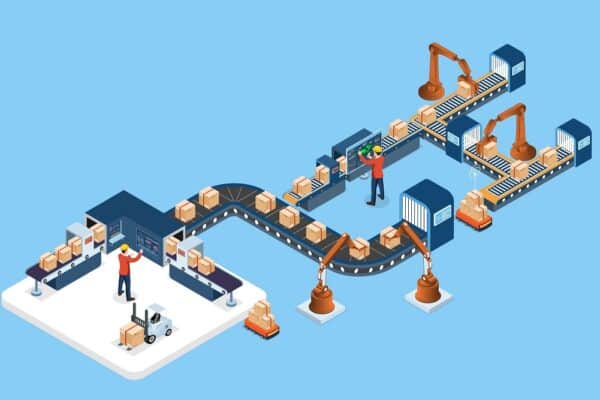
While the core concept of an FMS centers on adaptability, it’s important to recognize that there isn’t a single, uniform design. FMS solutions come in various configurations, each suited to different production needs and goals. Understanding these different types of FMS can help manufacturers choose the best approach to address their specific production bottlenecks.
At DEVELOP, our modular machine-building process allows us to create FMS solutions that offer a unique value proposition. We specialize in building systems that, while not fully dedicated to a single product, are instead optimized for a limited range of SKUs. This approach is particularly well-suited to medium-volume production lines.
- Cellular FMS: In a Cellular FMS, machines are grouped together to produce a family of similar parts, usually within a single manufacturing cell. This setup works well when a range of parts with similar processing requirements needs to be produced. It’s an approach that reduces setup time and increases production efficiency. These systems tend to excel in situations where there are several different variants of a specific product. Our modular approach is highly adaptable to the needs of a cellular system, allowing easy changes to tooling and process to accommodate the different variants.
- Line FMS: A Line FMS is designed for sequential processing of parts, where each part moves through a defined series of operations. This configuration is similar to a traditional production line but with the added flexibility of programmable equipment, designed to adapt to different products, allowing for some variation and rapid changeovers within the production flow. Our ability to create systems designed for 2-10+ SKUs works particularly well in these applications, delivering the perfect balance of efficiency and flexibility.
- Flexible Job Shop: The Flexible Job Shop represents a more complex FMS, designed for a high mix of products with varied processing requirements. It’s characterized by its ability to handle a wide range of product types and low-volume production runs, making it ideal for environments that demand a lot of variety and customisation.
The right choice of an FMS depends on your specific production goals, the variety of your product range, and the current issues your business is having with production bottlenecks.
FMS vs. Other Manufacturing Systems
To appreciate the unique advantages of a flexible manufacturing system, it’s helpful to understand how it compares to other approaches in manufacturing. While all manufacturing systems aim to produce goods efficiently, the approaches differ greatly in their adaptability and ability to respond to changing demands, which is essential for solving production bottlenecks.
- Dedicated Manufacturing Systems: Traditional, dedicated manufacturing systems are optimized for mass production of a single product, with inflexible machinery that’s purpose-built for that specific task. While they can achieve high production volumes, they lack the agility to accommodate product variations or changing market demands, which creates major issues if production bottlenecks occur due to an unpredicted need to change product output.
- Lean Manufacturing: Lean principles focus on eliminating waste and improving process efficiency. An FMS can support lean manufacturing by providing automated solutions for process and throughput improvement, reducing production time, waste, and over production. While a lean approach can help with efficiency, an FMS often introduces a greater level of automation and flexibility.
- Agile Manufacturing: Agile manufacturing aims to respond rapidly to market changes and customer needs. A flexible manufacturing system directly supports agile manufacturing because it’s been designed for rapid changeovers, customization, and short production runs. Unlike traditional approaches that are less adaptable, an agile FMS will allow you to respond quickly and effectively to new market demands by simply changing the program of the production machines or their tooling.
Choosing the right system means matching the right approach to your specific business objectives, with an FMS offering unparalleled flexibility and responsiveness to changes within manufacturing.
DEVELOP’s Approach to FMS
At DEVELOP, we don’t just integrate flexible manufacturing systems, we engineer them. We know from experience that “off-the-shelf” simply won’t do for all processes, and each unique requirement deserves special attention. That’s why we specialize in developing fully custom FMS solutions. We work closely with you as a partner, to create a system designed to address your unique needs, challenges, and opportunities.
Key Benefits of Flexible Manufacturing Systems
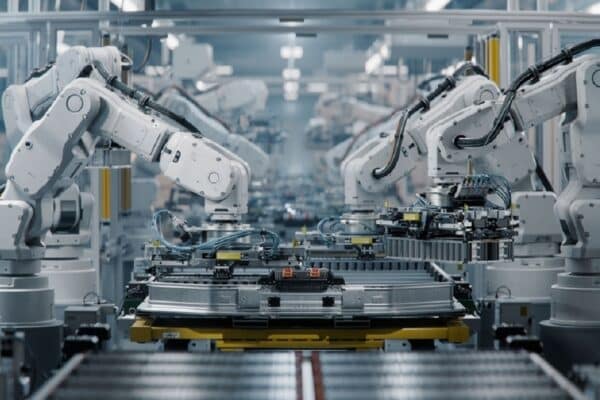
The advantages of adopting a flexible manufacturing system are numerous and can significantly impact a company’s operational efficiency and competitiveness. Traditional manufacturing methods often encounter production bottlenecks – points in the process where work slows down or stops due to rigid equipment, limited flexibility, or complex changeovers. FMS aims to address these issues head-on.
Agility & Adaptability
Perhaps the greatest strength of a flexible manufacturing system is its capability to quickly adapt to fluctuating demand, variable product lines, and custom jobs. Picture a system that doesn’t require costly downtime for a complete line retool for new SKUs.
An FMS allows that through the use of modular automation, software changes, and user-friendly operation. DEVELOP will deliver a streamlined manufacturing process for multiple SKUs that can provide fast, easy changeover and allow you to quickly respond to a variety of different demands.
Reduced Downtime
Unplanned downtime can create severe inefficiencies in your production cycle and seriously reduce profitability. FMS helps minimize that risk. A carefully designed, flexible manufacturing system consists of modular components that are easier to access, maintain, and replace, if required. At DEVELOP, we’ve invested heavily in our Human-Machine Interface (HMI), dedicating 2 years to its initial development.
Our intuitive HMI allows for smoother operation and reduced downtime, and provides visibility of key data such as uptime, job status, and maintenance needs. That allows for smoother operation and less need for costly manual changeovers, protecting overall uptime for production lines. The HMI also enables proactive maintenance and rapid responses, further reducing the risk of downtime.
Increased Productivity & Efficiency
The enhanced adaptability of an FMS leads directly to a dramatic upsurge in both efficiency and productivity within your business. Tailor-made automation, designed specifically for your products, guarantees maximum output using minimal physical space, all while using the optimum process for a perfect end product. Intelligent automation enables operations with decreased labor inputs, streamlining processes, and freeing up your internal workforce.
Improved ROI and Lower Production Costs
Investing in flexible manufacturing systems is a strategic way to both reduce your production expenses and dramatically improve your return on investment. You can use an ROI calculator to accurately assess the potential benefits. By increasing adaptability, FMS reduces operational expenses, allowing for more efficient changeovers with less manual handling and downtime, leading to increased outputs and higher yields.
That adaptability provides long-term value and also future-proofs your processes by allowing your business to grow and evolve alongside your products with your existing machinery. Keep in mind the hidden ROI of automation – the less obvious benefits that go beyond pure numbers, like increased safety and improved product quality.
Future-Proofing Your Factory
Future-proofing a factory means making smart decisions about long-term operations and performance requirements. The core advantage of a flexible manufacturing system lies in its ability to adapt to a range of challenges and demands without compromising output. By thoughtfully incorporating FMS, companies can grow into new markets with minimal disruption and avoid expensive, unnecessary machinery purchases. A modern FMS provides the capacity for expansion and alteration as needed, ensuring your factory can respond to evolving business needs.
Related Reading: A Complete Guide to Automated Factories and Lights Out Manufacturing
Using Data to Optimize Your Flexible Manufacturing System
An FMS generates a significant amount of data, which can be crucial for ongoing performance optimization and addressing any potential production bottlenecks. Manufacturers that use their FMS effectively are often those that carefully monitor their systems and use that data to make informed decisions.
- Key Performance Indicators (KPIs): Measuring KPIs is crucial for monitoring an FMS. These KPIs can include throughput (units produced per time period), uptime (percentage of time the system is operational), Overall Equipment Effectiveness (OEE), or changeover times. By tracking these metrics, manufacturers can get a clear picture of the system’s performance and identify areas for improvement.
- Data Visualization: Data collected from the FMS can be visualized through dashboards and reports, which help to monitor system performance. This allows for more proactive management, and faster response times to problems with a focus on proactive solutions. The remote access to a PowerBI dashboard that’s made possible through our HMI provides a clear and detailed overview of system performance.
- Predictive Maintenance: Modern FMS setups often feature data analytics, and the data generated by the system can also be used for predictive maintenance. It allows manufacturers to anticipate maintenance needs, reduce downtime, and prevent equipment failure, ensuring more consistent and efficient production and eliminating the risk of unexpected production bottlenecks caused by machine failure. Our HMI system greatly contributes to this through real-time data collection and reporting.
By tracking, analyzing, and using data, you can gain the insights required to continuously improve performance and increase the overall ROI of your flexible manufacturing system.
DEVELOP’s Approach to Designing and Implementing Flexible Manufacturing Systems
What sets DEVELOP apart is our in-house engineering team. We don’t just assemble equipment, we design and engineer comprehensive solutions tailored to your unique needs. While other providers might select “off-the-shelf” systems for any challenge, we use our extensive experience and data to design innovative, semi-custom solutions for every individual application. Our process is rooted in the intelligent application of existing designs and data, allowing us to build machines in a shorter period of time, with greater reliability. This is achieved by using information captured from our existing machines, which is used to inform future designs.
Vertical Integration for Speed and Control
Our vertically integrated approach means that we control every step of the manufacturing process, from design and development to final production. This complete control gives us a significant advantage in speed and responsiveness. Unlike companies that rely on multiple external suppliers, we’re able to react swiftly to ever-changing designs or tight timelines.
We maintain strong in-house resources and expertise across all stages of your project, enabling us to work closely with you throughout the entire process. From an initial Automation Assessment and concept development, all the way through to system implementation and final manufacture, we’re your collaborative partner. This level of collaboration, combined with our reduced reliance on external providers, ensures a far quicker turnaround time and more efficient operations.
Interested in finding out if your factory is ready for automation? Take our free Automation Assessment Questionnaire and discover your automation options.
Modular Design & Configurable Systems
We believe in a modular approach that ensures flexibility and longevity for every FMS we deliver. Our systems feature reconfigurable equipment with easily reprogrammable HMIs, allowing them to handle a wide array of products and SKUs. A modular design means that when products change or additional equipment is needed, our systems can adapt to meet your future production requirements with ease. Our configurable software also ensures smooth integration with any hardware adjustments, minimizing downtime for your team and ensuring a smooth transition.
Proven FMS Expertise with Different Equipment Types
Our extensive experience spans a broad range of manufacturing processes and systems, from packaging and palletizing solutions to specialist equipment such as bespoke extrusion and CNC machining. Our expertise is particularly valuable when developing flexible manufacturing systems. We know that an effective FMS must integrate various technologies and processes with ease.
Whether your project involves complex material handling, specialized fabrication, or high-volume throughput, DEVELOP’s broad background ensures we can create an FMS solution tailored to your unique needs and challenges. Our wealth of knowledge across these areas will bring significant added value, whatever the specific nature of your project.
Addressing Bottlenecks from Day One
We make it our mission to understand your unique project challenges and constraints from the very beginning. By doing so, we can create an optimized FMS design that’s tailored to your exact needs. Our targeted approach ensures our flexible solutions tackle your existing production bottlenecks, leading to higher and more consistent output well into the future. With DEVELOP, you get a carefully planned system designed for long-term efficiency and productivity.
Start Achieving ROI with Flexible Manufacturing
By partnering with DEVELOP, you’re choosing more than just an integrator of components. You’re choosing a highly skilled strategic partner that places innovative engineering processes and optimized design at the core of the final flexible manufacturing system. We analyze your entire manufacturing process thoroughly, focusing on all components and their relationship to your broader operations and future plans. This allows us to design highly efficient overall processes, maximizing output while delivering optimum value and return on investment. Our goal is to create a system that works in harmony to achieve your business objectives.
Don’t let production bottlenecks hold you back any longer. Contact DEVELOP today to start a consultation with our experienced engineers and discover how flexible manufacturing systems can turn your challenges into innovative opportunities, helping you to achieve long-term success.
Contact Us Today
About the Author:
Matt Moseman leads as President of DEVELOP, with a strong foundation from the Milwaukee School of Engineering, where he earned both a Bachelor’s and a Master’s in New Product Management. Moseman’s career highlights include his pivotal role in founding NodeUDesign, innovating in automation hardware, and driving DEVELOP LLC to the forefront of industrial robotics with a focus on enhancing productivity and efficiency.