
What This Means for Robotics Integration in Real Production Environments
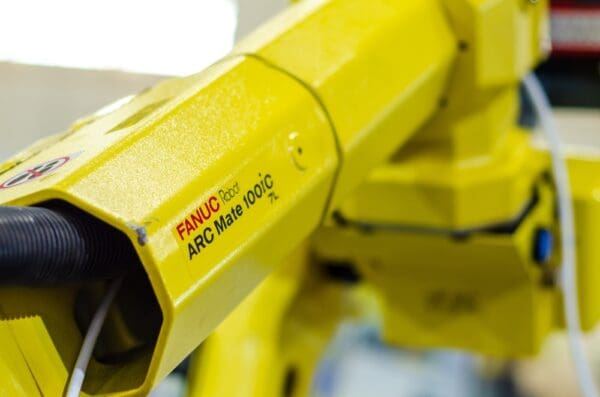
DEVELOP LLC is now a FANUC Authorized System Integrator. Designation as an authorized partner confirms that our engineering team is trained and validated on FANUC robotics, including programming, safety, and full system integration.
Recognition as a FANUC system integrator works in tandem with our status as an A3 Certified Robot Integrator. For manufacturers, the value lies not in the robot itself, but in how the turnkey automation systems perform once they’re running in production.
What FANUC Authorization Requires
Becoming a FANUC Authorized System Integrator requires formal training, system validation, and adherence to defined engineering and safety standards. It requires demonstrating that robotic systems are designed and integrated to perform reliably under real operating conditions.
Alignment with these standards mirrors how DEVELOP approaches automation projects from the start.
Where Robotics Projects Succeed or Fail
Most automation projects are not limited by the robot, but by how the system is defined before the robot is selected. Cycle time assumptions, product variation, operator interaction, and upstream and downstream dependencies all influence how the system performs.
If those factors are not resolved early, the system may function, but it will not run consistently without ongoing intervention.
Real-World Execution: High-Speed Robotics in Practice
Performance is proven through real systems running in production. DEVELOP recently integrated a robotic automation cell featuring a FANUC robot operating within a fully enclosed production environment.
Key project details included:
- Robot Selection: A FANUC robot selected for high-speed, repeatable operation.
- Environment: A fully enclosed automation cell designed to meet rigorous robotics safety standards.
- System Design: Controls and end-of-arm tooling designed around the specific process.
Successful integration ensures that the technology fits the process rather than forcing the process to fit the machine.
How We Integrate FANUC Robotics
Robotics is integrated as part of a complete, stable system. Robotics integration services include:
- End-of-Arm Tooling Design: Tooling engineered for real product variation.
- Conveyor and Controls Integration: Maintaining flow and data velocity across the entire system.
- Operator-Focused HMIs: Interfaces that operators can use without extended FANUC robot programming training.
- System Layouts: Architectures that support long-term maintenance and maximize uptime.
Mechanical, electrical, and controls engineering are developed together and carried through the build and installation by the same team. Decision alignment reduces rework once the system reaches production.
How FANUC Fits Into the Process
FANUC authorization ensures that robotics are implemented correctly when they’re the right fit. The first step is determining whether robotics should be used at all.
That work is done during an Automation Assessment.
We evaluate how the process runs, capture production data, and define how the system needs to perform. From there, we determine where robotics improves throughput, stability, or labor dependency, and where it introduces unnecessary complexity.
Some systems move forward with robotics. Others are better solved through changes to the process or product design before automation is introduced.
What This Means for Your Operation
For manufacturers, our process translates into more predictable system performance. Working with a FANUC Authorized System Integrator ensures that robotics are applied with a clear understanding of system performance requirements.
- Systems are designed around real production conditions
- Robotics are integrated where they deliver measurable impact
- Engineering decisions are based on process data, not assumptions
- Turnkey automation systems are built to run consistently once they are live.
Evaluating Robotics for Your Operation
If you’re considering robotics, the first step is understanding how it fits into your process and what it will take to make it work in production.
That work defines whether automation delivers consistent performance once it is installed.